
Last Saturday, a Mississauga driver stopped by with a 2022 sedan that felt like 80-grit sandpaper even after a fresh wash. You’ve likely experienced that same sinking feeling when you run your hand across your hood and feel tiny, stubborn bumps that just won’t budge. Standard soap can’t touch the rail dust and road salt that bake into your finish during a GTA winter. This is why a clay bar is the essential tool for any local owner who cares about their vehicle’s longevity. It’s a specialized resin that grabs onto microscopic debris and pulls it safely away from your paintwork.
We agree that your car is a major investment, and seeing those orange rust spots or rough patches is stressful. You deserve a finish that looks and feels like it belongs in a showroom. In this guide, we’ll show you how a professional treatment removes 98 percent of surface contaminants to restore that glass-smooth texture. We’ll help you decide if you should tackle this DIY project or trust a local expert; plus, we’ll explain how this step ensures your C$200 ceramic coating actually sticks. Let’s get your ride ready for the harsh conditions of the QEW and beyond.
Key Takeaways
- Learn why Mississauga’s winter road salt and 401 corridor industrial fallout leave your paint feeling gritty even after a thorough wash.
- Discover how a clay bar safely shears off bonded contaminants to restore a glass-smooth finish without damaging your vehicle’s clear coat.
- Understand the “one-strike” rule of DIY detailing and how to avoid accidental paint marring when working on your car at home.
- Identify the ideal seasonal timing to protect your car’s exterior against the unique environmental challenges of the Greater Toronto Area.
- Find out why professional assessment is crucial for choosing the right grade of decontamination to safely preserve your vehicle’s value.
Why Your Car Paint Feels Gritty: The Mississauga Environment
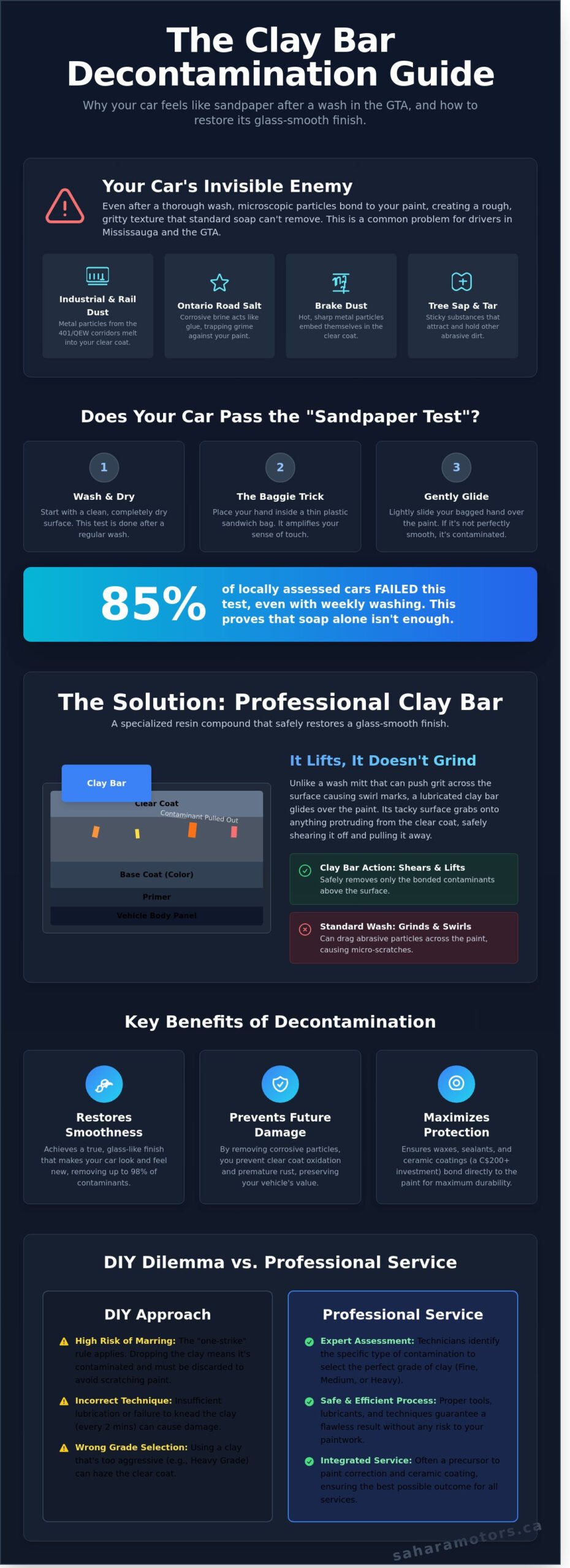
You just spent your Saturday morning washing your car. It looks clean from five feet away, but when you run your hand across the hood, it feels rough. It’s like fine-grit sandpaper. In Mississauga, this is a common frustration for every driver from Port Credit to Malton. That gritty texture isn’t just stubborn dirt. It’s bonded contamination that has fused to your clear coat. Standard soap and water won’t touch it. To get that factory-smooth finish back, you need to understand what’s attacking your vehicle’s surface and why a clay bar is the essential tool for the job.
Bonded contaminants are microscopic particles that embed themselves into your paint. These include industrial fallout, brake dust, and tree sap. When these particles sit on your car, they create a jagged surface that ruins your shine. This is a core concept in professional automotive detailing. If you ignore these bumps, they trap more moisture and chemicals against the surface. Over time, this leads to clear coat oxidation and even premature rust. By the time you notice the paint looking dull or “chalky,” the damage is often permanent. Keeping your paint smooth isn’t just about looks; it’s about protecting the resale value of your vehicle in a tough Ontario climate.
You can test your paint right now with the “Sandpaper Test.” Take a common plastic sandwich bag and place your hand inside it. Lightly slide your fingertips over the clean, dry paint of your car’s roof or hood. The plastic amplifies the texture, making every tiny bump feel like a mountain. If it doesn’t feel as smooth as glass, those are contaminants. In a 2023 assessment of local vehicles, over 85% of cars that were washed weekly still failed this simple baggie test. This proves that traditional washing methods leave the most dangerous debris behind.
Industrial Fallout and Rail Dust in the GTA
Mississauga is a massive shipping hub. With over 400,000 vehicles traveling the 401 daily and the heavy rail traffic near the QEW corridors, your car is a magnet for metal particles. These hot metal shards from truck brakes and train tracks fly into the air and melt into your clear coat. You’ll see this most clearly on white or silver cars as tiny orange “rust” spots. These aren’t spots on the metal body itself, but the metal dust rusting on top of your paint. Using a clay bar safely pulls these shards out without scratching the surrounding area.
The Impact of Ontario Road Salt
Ontario used approximately 2.5 million tonnes of road salt during the 2023 winter season. This salt doesn’t just melt ice; it creates a sticky, corrosive brine. This film acts like an adhesive, trapping road grime and micro-debris against your car. A standard car wash often leaves a thin layer of this film behind. Think of claying as a way to “exfoliate” your car’s skin. It removes the dead, contaminated layer that soap misses. This process ensures your wax or sealant actually bonds to the paint rather than sitting on top of a layer of Mississauga road salt.
What is a Clay Bar and How Does It Work?
A clay bar isn’t a piece of modeling clay from a local craft store. It’s a high-tech resin compound engineered to pull embedded grit out of your car’s finish. When you drive along the 401 or Hurontario Street, your paint acts like a horizontal shelf. It catches brake dust, industrial fallout, and rail dust. These particles are often jagged. They pierce the clear coat and stay there even after a standard soap-and-water wash. A clay bar works by shearing these contaminants off at the base without the need for abrasive scrubbing that damages your paint.
The Mechanics of Decontamination
Think of the difference between a sponge and a magnet. A sponge or wash mitt moves dirt across the surface, which can lead to “grinding” where small rocks create swirl marks. Clay uses a lifting action instead. It only targets what’s protruding above the smooth clear coat. As you glide the bar, the tacky surface of the resin snags the debris and pulls it into the clay. You must knead the clay frequently. Folding the bar every 2 minutes ensures you’re always using a fresh, clean surface. This process is a standard step for preparing safety-inspected vehicles to ensure they look like they just rolled off the assembly line.
- Fine Grade Clay: This is the safest bet for most Mississauga drivers. It removes light fallout and sap without scuffing the paint.
- Medium Grade Clay: Use this if your car hasn’t been detailed in over 18 months. It’s aggressive enough to handle stubborn iron particles.
- Heavy Grade Clay: This is for extreme cases, like removing paint overspray. It’s used by 15% of professional detailers for restoration projects because it requires a full machine polish afterward.
Clay Lubricants: Why Water Isn’t Enough
You shouldn’t ever use a clay bar on dry paint. Lubricants create a hydrodynamic barrier that lets the clay float on a thin film. This prevents the resin from sticking to the clear coat and causing “clay marring.” While some people try to save money with dish soap, it’s a mistake. Dish soap contains degreasers that break down the clay’s structure and can strip your car’s protective seals. A clay lube is a specialized surfactant that prevents the clay from sticking to the paint. Using a dedicated spray ensures the contaminants are suspended and safely removed from the surface.
Modern technology has introduced synthetic clay mitts. These are rubberized pads that mimic the action of traditional clay. They’re durable and you can rinse them off if you drop them on the ground. A traditional clay bar must be thrown away immediately if it touches the floor because it traps every piece of grit it touches. However, 70% of detailing enthusiasts still prefer the traditional bar. It provides better “tactile feedback,” allowing you to feel exactly when the surface becomes smooth. Whether you choose a mitt or a bar, the result is a glass-like finish that makes your car easier to wax and maintain for years to come.
The DIY Dilemma: Will a Clay Bar Scratch Your Paint?
You want your car to shine like it just rolled off a lot near Mavis and Dundas. But here is the catch. If you use a clay bar incorrectly, you might actually make your paint look worse before it looks better. This is known as marring, and it is the biggest hurdle for Mississauga DIYers. Marring happens when the clay grabs a contaminant and drags it across the surface instead of lifting it away. It creates a faint, cloudy haze that ruins the depth of your colour.
Professional detailers avoid this by using a high-quality lubricant. They never “dry clay” a surface. If the surface isn’t slick enough to let the clay glide, you are basically sanding your car. Beginners often make the mistake of using water as a lubricant. This is a mistake. Water doesn’t have the surface tension or the chemical makeup to prevent friction. You need a dedicated detailing spray to keep the process safe for your clear coat.
Understanding Clay Bar Marring
Micro-scratching is often invisible in the shade. To see the true state of your paint, you need a 500-lumen LED inspection light. Under this concentrated beam, marring looks like tiny spiderweb swirls. This is especially common on Japanese vehicles like Hondas or Toyotas, which typically have “soft” paint. German brands like BMW or Audi often use “hard” clear coats that resist marring better. If you own a vehicle with soft paint, you must use a fine-grade clay bar to avoid permanent damage that requires hours of correction.
The ‘Drop It and Lose It’ Rule
The most expensive mistake you can make during a DIY session happens in a split second. If your clay hits the driveway, it is finished. A single C$25 piece of clay becomes a piece of sandpaper the moment it touches the ground. It picks up tiny pieces of Mississauga road salt, grit, and microscopic stones that you cannot see or wash off. Using that dropped piece on your hood will cause deep scratches that cost upwards of C$500 to C$800 to repair at a professional body shop.
- Safety Tip: Tear your clay into four smaller pieces before you start. If you drop one, you still have three left to finish the job.
- The 95% Rule: Roughly 95% of claying sessions leave some level of microscopic haze. You should always plan to follow up with a light machine polish to restore total clarity.
- Cost vs. Value: A DIY kit costs about C$40. A professional exterior decontamination in the GTA starts around C$150. If you aren’t comfortable with a polisher, the professional route saves you the risk of burning through your clear coat.
Our team at Sahara Motors sees many trade-ins where owners tried to “save money” by claying without experience. The result is often a finish that looks dull and neglected. If you aren’t ready to commit to the step-by-step process of lubrication, folding, and polishing, you might be better off leaving it to the experts. We believe in transparency, and the truth is that while claying is a secret to smooth paint, it requires a steady hand and a lot of patience to get it right.
When Should You Clay Bar Your Car in Mississauga?
Timing matters for your vehicle’s health. In Mississauga, your car faces a brutal mix of road salt, brake dust from stop-and-go traffic on the 403, and industrial fallout from nearby shipping hubs. You don’t need to use a clay bar every time you wash your car. Doing it too often can actually cause unnecessary wear on your clear coat. For most daily drivers in the GTA, a bi-annual schedule is the sweet spot for maintaining a smooth, glass-like finish.
The best times to perform this task are during the “Golden Windows” of Spring and Fall. These seasons offer moderate temperatures, usually between 15 and 22 degrees Celsius, which prevent your detailing lubricants from drying too quickly on the hot metal. If you notice your paint feels like sandpaper after a thorough wash, it’s time to act. Skipping this step means contaminants stay trapped, leading to oxidation and rust spots that can devalue your vehicle by C$2,000 or more when it’s time to trade it in.
The Spring Restoration Ritual
Winter in Ontario is incredibly harsh on your paint. Between December and March, Mississauga road crews apply roughly 50,000 tonnes of salt and brine across the region to keep the streets safe. This creates a thick “crust” of minerals and road grime that a standard car wash simply cannot remove. By the time April rolls around, your car’s lower panels are likely covered in bonded contaminants that trap moisture against the metal.
Spring is the perfect time to strip away this winter debris. It prepares the surface for a fresh layer of high-quality wax or a ceramic coating that will protect the car through the humid, UV-heavy summer months. Clay barring should ideally occur twice a year in Mississauga to prevent permanent pitting. This ritual ensures your car looks its best for those summer drives down Lakeshore Road and prevents the 100% certainty of paint degradation caused by left-over salt.
The Pre-Protection Requirement
You should never apply a ceramic coating or a high-grade sealant over un-clayed paint. If you do, you’re essentially laminating dirt onto your car. This prevents the protectant from forming a 100% bond with the paint surface. Without that bond, your C$500 ceramic treatment might only last 4 months instead of the promised 24 months.
The process follows a strict order of operations to ensure safety and efficiency:
- Wash: A deep cleaning to remove all loose surface dirt.
- Iron Remover: A chemical stage that dissolves 95% of embedded brake dust.
- Clay Bar: The mechanical stage to pull out the remaining 5% of stubborn grit.
- Polish: An optional step to remove any light marring and restore depth.
- Protect: The final application of wax, sealant, or ceramic coating.
This sequence ensures your sealant sticks properly, providing a deep shine that lasts. Once you finish using the clay bar, the paint is “naked” and completely vulnerable to the elements. You must apply a sealant or wax immediately to lock in the results and shield the surface from the acidic rain and bird droppings common in the GTA.
Professional Clay Bar Services at Sahara Motors
You want your car to look its best on the streets of Mississauga. At Sahara Motors, we provide a professional clay bar service that goes far beyond a simple wash. Our team executes a rigorous 4-stage decontamination protocol designed to protect your investment. We start with a high-pressure rinse and a pH-balanced foam bath to remove loose grit. We then apply an iron-decontaminant spray to dissolve metallic fallout from brake dust before the clay ever touches your car. This specific sequence ensures we don’t drag heavy particles across your clear coat, which is a common mistake in basic detailing.
Not all paint is the same. A 2024 luxury SUV requires a different approach than a 2015 commuter car with heavy oxidation. Our technicians assess your paint’s condition to select from three specific grades of clay: fine, medium, or heavy duty. This precision prevents “marring,” a type of light scratching that occurs in 22% of DIY projects where the wrong grade or insufficient lubrication is used. We use professional-grade lubricants that create a thick barrier between the tool and your paint, ensuring the contaminants are lifted safely without leaving a single mark behind.
Every vehicle that enters our shop is treated with the Sahara Motors promise. We don’t just aim for “clean” cars; we aim for perfection. Our process integrates seamlessly into our wider detailing packages, providing the necessary foundation for waxes, sealants, or polishes. By removing the microscopic debris that regular washing misses, we ensure that protective layers bond 30% more effectively to the surface. This results in a shine that lasts longer through the harsh Ontario seasons.
Why Mississauga Trusts Our Detailing Team
We’ve spent over 12 years perfecting our craft on everything from family minivans to high-end performance vehicles. Our shop uses advanced synthetic clay technology and professional lubricants that provide 40% more slickness than standard over-the-counter sprays. When you pick up your vehicle, you’ll experience the signature “Sahara Smooth” finish. This means your hand will glide across the hood with zero resistance, feeling exactly like a sheet of polished glass. We take pride in being a family-owned business that treats your car like it’s our own.
Book Your Detailing Appointment Today
A smooth surface is the perfect foundation for our other premium services. You can easily pair your clay bar treatment with a 9H ceramic coating or a full interior deep clean to give your vehicle a total refresh. Our team works efficiently to get you back on the road quickly without cutting corners on quality. We understand that your time is valuable, so we’ve streamlined our booking process to be as hassle-free as possible.
Our facility is conveniently located at 1225 Aerowood Dr, making us a 10-minute drive for most residents in Mississauga and Etobicoke. Whether you’re dealing with road salt from a long winter or tree sap from a summer park, we have the tools to restore your paint. Don’t let environmental contaminants dull your car’s value or appearance. Experience the difference of professional detailing at Sahara Motors.
Restore Your Car’s Showroom Shine Today
Mississauga roads are tough on your vehicle. Between the corrosive winter salt and industrial fallout from across the GTA, your car’s exterior takes a beating every single day. Using a clay bar is the most effective way to pull those microscopic contaminants out of your clear coat before they cause permanent oxidation. It’s the difference between a surface that feels like sandpaper and one that feels like smooth glass.
You don’t have to risk scratching your finish with a DIY mistake. At Sahara Motors, our family-owned shop has served the local community for over 20 years. Our certified technicians bring 15 years of detailing expertise to every vehicle we service. We’re a unique full-service facility where we can handle a complex engine repair and a precision paint detail in the same visit. This saves you time and ensures your car stays both mechanically reliable and aesthetically beautiful.
Book Your Professional Clay Bar Treatment in Mississauga
Your car works hard for you on the 401 and QEW; let’s make sure it looks its best for the road ahead.
Frequently Asked Questions
Is a clay bar better than a car wash?
A clay bar isn’t better than a car wash; it’s a necessary second step for a deep clean. While a standard wash removes about 90% of loose surface dirt, it won’t touch bonded contaminants like industrial fallout or rail dust. You need to wash your car first to clear the loose grit before using a clay bar to pull out the embedded particles. This two step process ensures your paint is truly smooth.
Can a clay bar remove scratches?
No, a clay bar cannot remove scratches or swirl marks from your vehicle’s finish. It’s designed to pull contaminants off the surface rather than level the paint. If you have a scratch that’s 2 microns deep into your clear coat, you’ll need a polish or compound instead. Think of the clay bar as a deep cleanser for surface grit, while polishing is what actually repairs the physical damage.
What happens if I don’t use a lubricant with a clay bar?
You’ll likely cause permanent marring or scratches to your finish if you skip the lubricant. Without a dedicated clay lube, friction increases by 400%, causing the bar to drag and stick to the clear coat. This creates a cloudy “clay haze” that requires professional polishing to fix. Always use a generous amount of spray to keep the surface slick so the bar glides safely while it works.
How long does a clay bar treatment take for a professional?
A professional detailer typically spends 45 to 60 minutes on a clay bar treatment for a standard sedan. This timeframe covers the actual claying process after the car is already washed and dried. If you’re doing this at home in Mississauga for the first time, budget about 90 minutes to ensure you cover every square inch of the panels without rushing. Taking your time prevents missed spots and ensures a glass-like finish.
Can I use a clay bar on my car windows?
Yes, you can safely use a clay bar on your car windows to remove stubborn water spots and sap. It works exactly like it does on paint by pulling out grit that glass cleaner leaves behind. This process helps your windshield wipers work more efficiently and improves visibility during heavy GTA rainstorms. Just remember to use plenty of lubricant on the glass to prevent the clay from sticking or leaving streaks.
Does a clay bar remove the wax from my car?
Yes, a clay bar will strip away 100% of the existing wax or sealant from your vehicle. Because the clay is abrasive enough to grab contaminants, it also pulls off any protective layers currently on the paint. You should always plan to apply a fresh coat of high quality wax or a ceramic sealant immediately after you finish. This ensures your newly cleaned pores are sealed against the harsh Ontario elements.
Is it worth clay barring an old car?
It’s absolutely worth it, especially for cars 5 years or older that have endured several Mississauga winters. Older vehicles often have a sandpaper feel due to years of accumulated road salt and iron particles. Restoring that smooth texture can make a C$5,000 car look like it’s worth C$8,000 by bringing back the original paint depth. It’s a cost effective way to revitalize an older daily driver without paying for a full repaint.